

Why the Confusion?
Borescope vs endoscope confusion is common, and many people use the terms interchangeably even though they serve different purposes. While both are inspection tools that allow you to see inside tight and hidden spaces, one is built for machines and the other for medical use. This blog will explain their differences, ideal applications, and help you choose the right tool for your inspection needs.
In reality, borescopes and endoscopes serve distinct purposes and users. This blog will clarify the differences, explain use cases for each (industrial vs. medical), and help you understand which tool you really need. By clearing up the terminology, we’ll also guide anyone searching for an “industrial endoscope” or “inspection endoscope” toward the proper solution. Zibra Corp, as a leader in industrial micro borescope systems, is here to help you choose the right inspection camera for machinery and avoid common misconceptions.
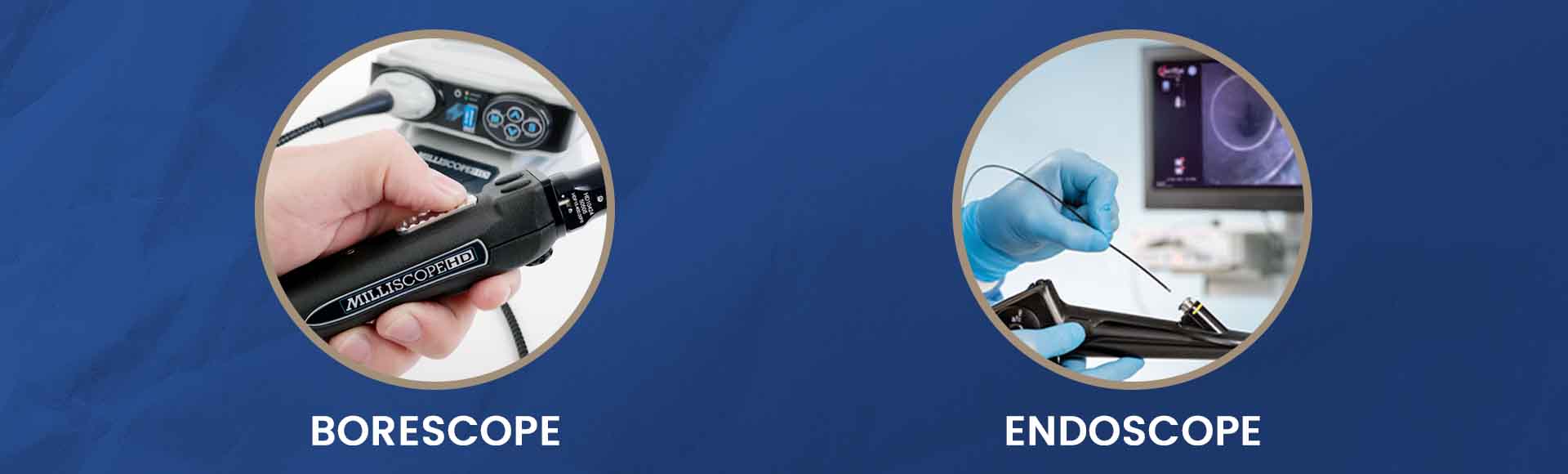
What is a Borescope?
A borescope is an optical inspection tool used to view areas that are otherwise inaccessible in machines, structures, or other industrial applications.
In simple terms, it’s a camera or eyepiece on the end of a rigid or flexible tube, designed to be inserted into equipment without needing to take that equipment apart. Borescopes let engineers, technicians, and inspectors see inside engines, pipes, walls, turbines, virtually any hard-to-reach cavity; to check for defects, blockages, or wear without destructive disassembly.
Borescopes come in various forms:
- Rigid borescopes: A straight, inflexible tube useful for inspecting straight-line paths (like gun barrels or machined holes).
- Flexible borescopes (fiberscopes/videoscopes): A bendable cable that can snake through curves and bends. These often use fiber optics or tiny cameras to transmit images. High-end versions have articulating tips that the user can remotely steer to look around corners.

Common uses: Borescopes are widely used across industries such as aerospace, automotive maintenance, energy, manufacturing, construction, and law enforcement. For instance, aviation technicians use borescopes to inspect inside jet engines and turbine blades for cracks or debris without dismantling the engine. Mechanics use them to look inside car cylinders or behind dashboards. Electricians and plumbers might use borescopes (often called inspection cameras) to check inside walls, conduit, or pipes. Home inspectors can investigate cavities for mold or pests. Police and security teams even use borescopes to look into suspicious packages or hidden compartments. In short, whenever you need to see the unseen within a machine or structure, a borescope is the go-to tool.
What is an Endoscope?
An endoscope is a medical instrument designed for doctors to look inside the human (or animal) body without surgery.
It’s essentially the medical counterpart to the borescope, built for internal examinations of living organisms. Endoscopes are most often associated with procedures like endoscopy, colonoscopy, bronchoscopy, or laparoscopy; where a doctor inserts a thin, flexible tube equipped with a camera and light into the body to visualize internal organs or cavities in real time. This allows for diagnosis and even treatment (like taking biopsies or removing polyps) with minimal incisions.
Key characteristics: Endoscopes must be biocompatible and sterilizable, to safely enter the body and be reused without causing infection. They are often more delicate in construction, using soft polymers and precisely engineered components to avoid harming tissues. The illumination on medical scopes is softer and dimmer than industrial ones, to avoid glare off moist tissue and prevent overheating inside the patient.

It’s worth noting that the concept of an endoscope can be applied outside medicine; indeed, using endoscopic tools for industrial inspections was tried historically (and modern fiberscopes are an offshoot of endoscope technology). However, when an endoscope is used in any non-medical context, it’s usually referred to by a different name. In fact, in industrial fields, “endoscopes” used for inspecting pipes, engines, and so on are commonly known as borescopes. The term endoscope in everyday usage almost always implies a medical instrument. Additionally, systems such as the EndoInspect, are borescopes specialized to inspect endoscopes.
Key Differences Between Borescopes and Endoscopes
While borescopes and endoscopes share a basic function (looking into inaccessible spaces with a camera and light), they differ in design, intended use, and capabilities.
Below are the key differences between these tools:
Intended Use & Field:
Borescopes are designed for industrial and mechanical inspections (think engines, turbines, pipes, and other equipment). Endoscopes, on the other hand, are medical devices intended for examining the inside of a human or animal body. In short, if it’s a machine or structure, you use a borescope; if it’s a patient, you use an endoscope.
Flexibility & Design:
Borescopes come in various formats. They can be rigid, semi-rigid, or flexible depending on the application. A rigid borescope may provide a straighter and clearer view in a straight path. Flexible borescopes, often called videoscopes or fiberscopes, can navigate bends when needed. Endoscopes are generally very flexible. They are built as long, slender tubes that can move through the curved pathways of the human body. Some medical endoscopes are rigid, such as certain arthroscopes, but most diagnostic endoscopes are highly flexible. Both tools can have articulation with steerable tips, but articulation is essential in many medical endoscopes to maneuver inside organs.
Diameter:
Endoscopes usually have an extremely small diameter because they must fit into narrow anatomical passages. They are often thinner on average than borescopes. Borescopes, in contrast, have a wide range of diameters. Industrial scopes can be larger since machinery often allows a bigger access port. Common diameters might be 4 mm, 6 mm, or greater for general-purpose borescopes. However, specialized micro borescopes exist that rival or exceed medical scopes in thinness. Some borescopes are under 1 mm in diameter. For example, Zibra Corp’s product line includes borescopes as small as 0.25 mm to inspect tiny parts.
The difference is that industrial users choose diameter based on the job’s needs, whereas medical endoscopes are as thin as necessary to minimize patient discomfort.

Materials & Durability:
Because of their different environments, the two tools are built from different materials. Endoscope insertion tubes are made of soft, medical-grade materials such as special polymers and rubberized coatings. This prevents irritation or damage to living tissue. They also must withstand rigorous sterilization processes including high heat autoclaves and chemical treatments. Borescope probe tubes are built for toughness. They may have braided metal sheathing such as tungsten or steel, along with abrasion-resistant layers to endure scraping against metal edges, high temperatures inside engines, or exposure to fuel and chemicals.
In short, an endoscope is delicate and patient-friendly, whereas a borescope is rugged and built for workshop or field use.
Field of View (FOV):
Borescopes often feature a wider field of view, such as around 120 degrees, so they can survey a broader area inside a cavity. This is useful in industrial inspection where the goal is to scan for anomalies across a wide scene, such as looking around an entire cylinder. Endoscopes typically have a narrower field of view, often around 90 degrees, which focuses on a smaller area at higher detail. This is appropriate for examining tissue up close. Medical endoscopes rely on maneuverability to see different angles rather than using an ultra-wide lens. This is partly because an overly wide view could distort the image or be difficult to interpret in a confined organ space.
Lighting:
Illumination needs differ greatly. Borescopes use bright and intense light sources, often LED lights at the tip, to illuminate dark interiors of machines and pipes. The goal is to flood the area with light to reveal cracks or defects since there is no risk of harming inanimate objects with brightness. Endoscopes employ gentler light, usually a cool light delivered through fiber optics or LEDs that is dimmed and diffused. This avoids glare from wet tissue and prevents heat buildup inside the body. Excessively bright light could damage sensitive tissue or cause discomfort.
Endoscope lighting is tuned for clarity and safety in biological conditions, while borescopes prioritize maximum visibility in dark and reflective industrial environments.
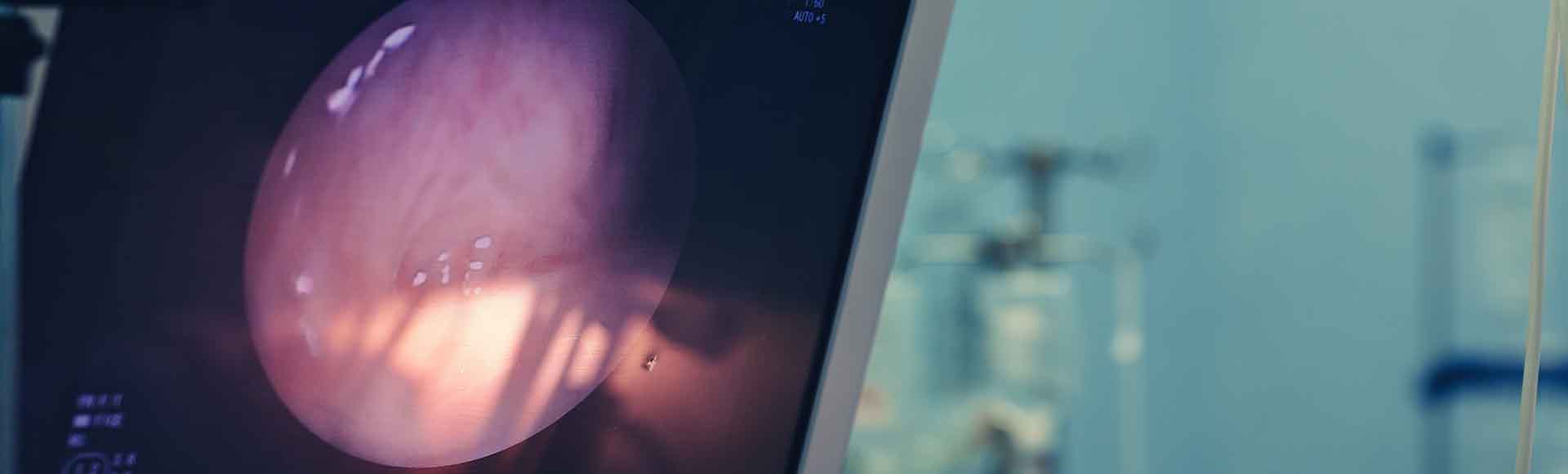
Image Quality & Detail:
Both devices aim for clear images, but their priorities differ. Endoscopes deliver extremely high-detail images. Medical-grade endoscopic cameras can produce HD or higher resolution with excellent color accuracy to differentiate tissues. This level of detail is critical because medical diagnoses and surgical precision depend on subtle visual cues. Borescopes can also offer high resolution, and many industrial videoscopes now provide HD imaging.
In practice, borescopes provide more than sufficient clarity to spot cracks, corrosion, or debris in machines. However, top-tier medical endoscopes still typically offer superior imaging finesse along with a significantly higher price.
Cost & Access:
Cost is a notable differentiator. Borescopes come in a wide price range from inexpensive consumer devices to advanced industrial systems costing $10,000 or more. Generally, industrial borescopes are less expensive than medical endoscopes. Medical endoscopes are specialized devices that can cost tens of thousands of dollars due to stringent medical standards, advanced optics, and a limited market. Anyone can buy and use a borescope, including technicians, hobbyists, and inspectors. Endoscopes are typically purchased by healthcare facilities and used by trained medical professionals.
A hobby mechanic or small business can easily obtain an industrial inspection camera, but a hospital-grade endoscope is not something available for personal use.
Summary: Key Differences Between Borescopes and Endoscopes
In summary, borescopes are purpose-built for industrial inspection needs, emphasizing durability, versatility, and ease of use in various mechanical scenarios. Endoscopes are purpose-built for medical examination, emphasizing patient safety, flexibility, and high precision. Understanding these differences will help ensure you get the right tool for the job.
Choosing the right inspection scope can be daunting, as there are many types, specifications, and use-case factors to consider. This is where Zibra Corp comes in as an industry leader and trusted advisor. Zibra Corporation is a premier designer and manufacturer of rigid, semi-rigid, and flexible micro borescope and videoscope systems. With over 40 years of expertise in optical inspection, Zibra Corp has built a reputation as the go-to source for precision industrial borescopes.

Ready to find the right scope for your application? Whether you need guidance choosing the best model, a custom configuration, or placing an order, our team will work with you to ensure you get the perfect solution for your inspection needs.